
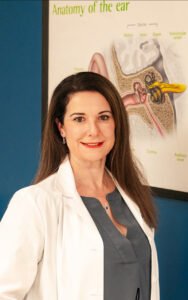
 Founder and Owner, Syracuse Hearing Solutions
With the organization since: 2009.
In current position since: 2009.
Education: Doctorate in audiology; master’s degree in neuroscience; bachelor’s degree in psychology.
Career Highlights: Publishing research articles, assisting in editing two scientific manuscripts, opening my practice, being a subject matter expert on an audiology standard of practice.
Current affiliations: Member at American Speech & Hearing Association, American Academy of Audiology, American Doctors of Audiology, Audiology Practice Standards Organization.
Skills that make you an effective leader? “Providing clear guidance, while still giving others independence to grow. I believe adapt quickly to situations, remaining flexible and staying focused on achieving results.”
How do you describe your managerial philosophy or approach? “I believe that we should always give our best, be sincere and honest.”
How do you personally demonstrate leadership and inspire your staff? “I always keep everyone focused on core goals and highlight how meaningful their work is, reminding them how much impact they have in changing and improving peoples’ lives.”
How do you see the healthcare industry changing in the next few years, and how will you prepare the organization for those changes? “We are in tough times in regards to changes in healthcare with the price of healthcare increasing and the demands outweighing the help that is available. We have seen reimbursement rates decrease by at least 4-6% over the past couple of years instead of increasing, yet premiums have increased. We have to be innovative, creative and efficient in how we approach and combat these challenges.”
What are your top three priorities for your organization within the next year? “Improve efficiency and effectiveness in our patient care; develop better ways to educate and teach patients about how important their hearing healthcare is and stress that it is not a do-it-yourself project; educate on the importance of always seeking help from a hearing healthcare professional who has expertise in preventing, diagnosing and treating hearing loss, tinnitus and balance problems associated with inner ear disorders.”
How can the healthcare industry in the region be improved? “Patients need better resources for hearing healthcare and removing barriers to healthcare due to financial status; we need to provide better information to help patients with their hearing and tinnitus concerns.”
Tell us one thing about you that people generally don’t know? “Hearing aids need to be precisely tuned to optimize how well the patient can hear. A well-fit hearing aid can improve a patient’s word understanding significantly. Follow-up maintenance on your hearing aids is important to make sure your hearing aids continue to work for you. Hearing difficulties may start off as subtle and go almost undetected until it begins to affect the hearing nerve connections, but by the time that starts, it is more difficult to regain some of the hearing abilities even with hearing aids. So, there is no reason to wait to seek help. There is a connection between untreated hearing loss and early cognitive decline, which may be preventable.”