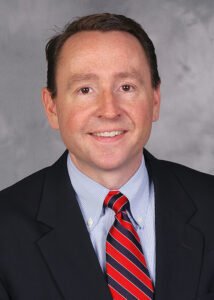
 Chief Financial Officer, Upstate University Hospital
With the organization since: 2008.
In current position since: 2008.
Education: Bachelor’s degree in economics, Westminster College; MBA, University of Rochester.
Career Highlights: Has served as chief financial officer of Upstate University Hospital for over 15 years. Oversees all financial functions for the hospital as well as patient access services, utilization management and retail and contract pharmacy operations. Among accomplishments is his role in facilitating and driving growth of the enterprise from $500 million in annual revenues to now more than $2 billion. Part of this growth was related to his key leadership role in the successful acquisition and integration of Community General Hospital. Also led an organization wide re-engineering of revenue cycle processes, facilitated the growth of retail pharmacy operations to over $200 million in revenues in five years, and drove a paradigm shift in the organization toward financial disciplines, which has resulted in the hospital earning profits in nine of the past 10 years despite cuts to state support. During the COVID-19 pandemic, was instrumental in monitoring hospital finances, ensuring funding for needed resources to fight the pandemic and working closely with the state and federal governments to address the financial implications of COVID-19 on hospitals and promoting appropriate methodologies for distribution of funds. Has been named to Becker’s List of Top Academic Medical Center CFOs to Know in 2022, 2023 and 2024. Prior to joining Upstate University Hospital, served in other divisional CFO roles for both Cigna, Inc (a national healthcare insurer) and Empire Blue Cross (a Medicare fiscal intermediary).
Current affiliations: Health Care Financial Management Association, Vizient CFO Council, New York State Society of Certified Public Accountants, American Association of Certified Public Accountants.
Skills that make you an effective leader? “Hire the best and give them the direction, tools and resources to do their jobs. My success is due to my ability to pick the right leaders and advocating to resource them in a way that benefits the organization.”
How do you describe your managerial philosophy or approach? “I believe in situational leadership. Adapting leadership styles is necessary to drive results in different situations or with different audiences.”
How do you personally demonstrate leadership and inspire your staff? “Anybody that knows me knows that I’m 100% sold out for the mission of Upstate — which simply put is to improve the lives of the communities we serve through healthcare, education and research. There are no bonuses or corporate ladders to worry about at Upstate. It’s never about me, it’s about expanding our impact on people’s lives. When others see that, I believe they respect what I’m trying to accomplish and join the cause. Also, who’s not motivated by saving lives? I tell people all the time that you don’t need to be a caregiver to save lives. Every person in every role at Upstate is an integral part of improving and saving lives daily.”
How do you see the healthcare industry changing in the next few years, and how will you prepare the organization for those changes? “Healthcare is changing at a very rapid pace. Healthcare costs for our nation have eclipsed 20% of our GDP and place a massive burden on federal and state budgets. I have no doubt that we will continue to see more hospital consolidations and pressures to find efficiencies or scale economies within the present system. We need to take calculated risks relative to growth, acquisitions and innovations to weather the coming storms.”
What are your top three priorities for your organization within the next year? “Strategic growth, improved efficiencies and cash generation/preservation.”
How can the healthcare industry in the region be improved? “For survival purposes, everyone is fighting over services and markets that produce margin. This ultimately ends up diluting quality, referring patients unnecessarily outside of our region, and increasing costs of delivery. In a different world, it would be great if we could effectively plan for services in a manner that prioritized the needs of the community over the individual institution. We also need more providers pulling their weight regarding safety net services to vulnerable populations. These services need to be expanded and shared more equitably.”
Tell us one thing about you that people generally don’t know? “I’m an avid fisherman and outdoorsman. I spend most weekends at the Salmon River in Pulaski fishing for steelhead trout from October through April.”