

The condition has been in the news after the death of Sen. Lindsey Graha
By Eva Briggs, MD
A medical condition in the news as I write this is aortic dissection. The aorta is the large artery that carries oxygen rich blood from the left ventricle of the heart to distribute it to the body.
The first section of the aorta travels upward and is called the ascending aorta. The next segment, the aortic arch, bends to form a U-turn.
The aorta continues down through the thorax (chest) as the descending aorta. The last segment continues through the abdomen as the abdominal aorta. Eventually it forks into the left and right common iliac arteries which continue to the lower body.
Important arteries branch off the aorta. First are the coronary arteries which supply blood to the heart muscle. The next large branch, the brachiocephalic trunk, splits into the right common carotid and right subclavian artery to bring blood to the right side of the head and the right arm respectively. Next is left common carotid which carries blood to the left side of the head. It’s followed by the left subclavian which supplies the left arm. As the aorta descends more branches supply other vital structures in the abdomen and pelvis.
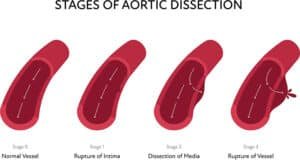
The aorta is a tube with three layers. Innermost is the intima. The middle layer is the media. The adventitia is the outer layer.
In an aortic dissection, blood enters via the intima and splits the media apart. The accumulating blood tears the media and may extend lengthwise up or down the aorta. This can block blood flow to blood vessels branching from the affected portion of the aorta. Sometimes the aorta ruptures causing catastrophic bleeding.
Aortic dissection affects about 3 per 100,000 people each year. It is more common in men. The average age is 63 but about 1 in 10 cases affects individuals less than 40 years old.
The most common initial symptom is chest or abdominal pain that often spreads to the back. The pain is usually severe. It may be mistaken for a heart attack. Other symptoms can depend on which blood flow is disrupted: fainting, stroke, heart failure, nerve damage, intestinal damage, and kidney damage.
The treatment of aortic dissection depends on the location of the dissection and the severity. Dissections in the first part of the aorta require surgery. Dissections in the more distant aortic sections can sometimes be treated with medication if there are no complications.
There are multiple risk factors for aortic dissection. It’s more common in those with high blood pressure. Another risk factor is a malformed heart valve called a bicuspid aortic valve. The aortic valve leads from the left heart ventricle to the aorta and normally has three segments called leaflets. An individual with a bicuspid aortic valve is born with two leaflets rather than three. Patients with previous heart surgery are also at increased risk.
The tissues forming the aorta are called connective tissue. Diseases that cause abnormal connective tissue increase the risk of aortic dissection. This includes Marfan syndrome and Ehlers-Danlos syndrome. Other risk factors include serious trauma, smoking, cocaine use, pregnancy, inflammation of the arteries, and high cholesterol.
The risk of death with aortic dissection is high. Almost 40 percent of people die almost instantly. Years ago, a friend of mine had an aortic dissection while she was hospitalized for a lung ailment and she died despite receiving immediate medical care in the hospital.
Measures that help reduce the risk of aortic dissection include blood pressure control, treating abnormal cholesterol, and quitting smoking.
 Eva Briggs is a retired medical doctor who practiced in Central New York for several decades. She lives in Marcellus.