
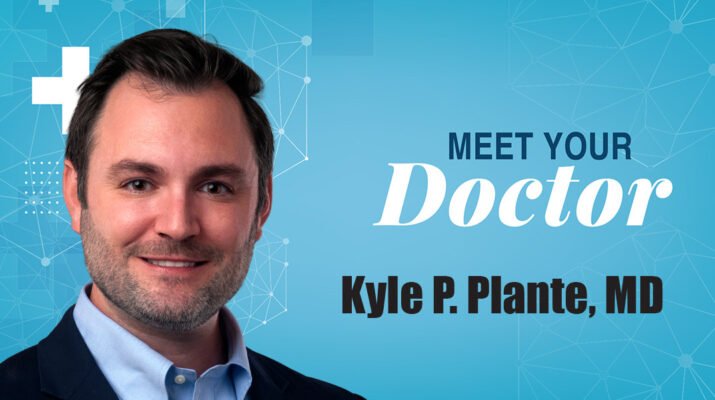
St. Joe’s primary care and sports medicine physician — who was a four-time men’s lacrosse scholar athlete in his college days — talks about tendinitis, concussion, and the need to stay active
By Chris Motola
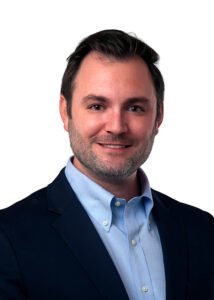 Q: Tell us about your practice at St. Joe’s.
A: I am a primary care provider. I do family medicine, so I see patients of all ages and I also do sports medicine. I did my residency in primary care and I did an extra year of fellowship training in sports medicine. I am split 50-50 between those.
Q: How well do those disciplines go together?
A: I think it’s really like a very natural fit. I tell a lot of my primary care patients that one of the best things we can do for them is to keep them active, keep them moving. It’s good for your mental health, your cognitive health, your physical health. So, reducing barriers for these patients as they age to help them remain as active as possible — it’s just good primary care, right?
Q: Can sports medicine be considered a kind of preventive care?
A: Yeah, I think absolutely. We’re not just treating injuries; we’re preventing them from coming back, too. In my primary care clinic or my sports medicine clinic, I’ll see patients for the first time, maybe suffering from an acute injury. But before they leave, we’re making sure we have a plan on how are we preventing this from recurring. Is it an overuse injury like tennis elbow or Achilles tendinitis, rotator cuff tendinitis? Those things can recur and stick around if you let it. I have a lot of posters on the walls and diagrams and pulling things up on my computer to show them how these joints are working and why they’re not working the way they’re supposed to and then how we go about fixing them. I think patients tend to participate in their treatment plans and therapy plans a bit better when they know why they’re doing what they’re doing, not just being told what to do.
Q: Tendons seem like the weak point when it comes to staying active as you age. But my impression is a lot of the conventional wisdom on the subject is wrong.
A: So, for one, not all tendon tears need a surgery or an intervention. Your tendons are subject to wear and tear like your joints. I tell people sometimes to think of some of these tendon issues as a rope that frays but may still have integrity. We can kind of help supplement those issues by strengthening up the muscles that support that joint that are around that tendon. There is a lot of circumstances where the tendon is not going to necessarily heal itself, but we might be able to strengthen the remaining portion of the tendon. Sometimes it’s about setting expectations, especially for an aging patient. Being completely pain free is sometimes not a reasonable expectation.
Q: It does seem like there’s a cognitive element to it, particularly when it comes to trade-offs between pain and function. Sometimes regaining function seems like it requires tolerating low-grade pain.
A: Oh, absolutely and I think sometimes it depends on the patient too. Some of my younger athletes are used to playing through pain. And some of the hard part as a sports medicine doctor, when I do team coverage, is figuring out when you can push through pain and when you can’t. Pushing through the pain doesn’t always lead to a benefit for them. And then, likewise, particularly with older patients, I want them to keep moving at all costs. I think again one of the expectations that go into a rehab protocol is that you can have a little bit of discomfort and it doesn’t necessarily mean it’s bad. That’s one of the things I really like about physical therapy. You have somebody who’s there in front of you and you can check in with them and say, “Is this normal? Am I supposed to have this type of discomfort?”
Q: Can tendons heal?
A: It depends on the degree of injury. If you tear that thing completely in half and disconnect it that’s the one end of the spectrum. If you tear a couple of the fibers, they can start to come around. It’s useful to distinguish between tendinitis and like tendinopathy as well. I tell people to think of tendinitis as more of an acute injury, acute inflammation; it’s angry for some reason that happened recently. Tendinopathy is maybe you’ve had prior injuries, multiple injuries, multiple bouts of tendinitis and the integrity of that tendon now is changed. It’s almost analogous to like a scar tissue where it has different tensile strength and elasticity. It’s a bit more prone to injury. So, we see tendinopathy quite a bit. Some of that’s a result of just being active your whole life. So, we would treat those two things very differently. One of the helpful things with being able to do point of care ultrasound in our clinic is that I can see these tendons. For superficial tendons like the rotator cuff, you’ll get better resolution than an MRI. With tendinopathy, healing is a bit more like tissue remodeling, which can take a while, anywhere from six weeks to a year and a half. So again, having a good physical therapist is invaluable, because if you don’t rehab correctly, you’re not going to get better.
Q: Can you give us a rundown on your concussion clinic?
A: It’s one of the big things that we do here that sets us apart. So, sports and non sports related concussions. Central New York doesn’t have a lot of providers for concussions. A lot of patients or parents end up bringing kids to urgent care or to emergency department and rarely do they end up needing actual imaging of their brain. We kind of have a rule here as far as our triage goes to try to get any acute concussion in within 72 hours, whether they’re double booking me or trying to fit them in. Because the earlier we’re able to recognize a concussion, the earlier we’re able to treat it and get them participating in a rehab program. They’re gonna get better faster. The magnitude of their symptoms are going to go down and especially for a young athlete, one of the best prognostic kind of factors for them. If they’re playing football, they’re going to get hit again. Not every hit is a concussion, but if they happen to get another concussion down the road, one of the best prognostic indicators is, did they have a well-treated concussion before? Or did it take months to get better?
I was trained in Buffalo under John Leddy. He came up with a protocol for returning to sports that was initially based off cardiac rehab protocols. We’ve learned that if you have a concussion, there is a whole metabolic cascade that occurs in your brain. And one of the big things is that you get a reduction in blood flow to your brain and you need blood flow to heal tissues, to heal tendons — you know, to heal anything — you need blood flow. And so you end up getting this energy mismatch.
Q: How do you untangle that to promote healing?
A: So, one way around that is to be active, starting lower aerobic physical activity to start increasing your heart rate a little bit. Over time, that’s going to increase blood flow to your brain, but it may actually worsen symptoms a little bit. But if you do it within reason — we call it the two–point rule. If you start your walk with a two out of 10 headache, it’s OK to go to a four out of 10 headache, but not further than that. So, it’s good to push a little bit. But push too much and you’re not going to benefit from that anymore.
Lifelines
Name: Kyle P. Plante, M.D.
Position: Family medicine and sports medicine physicians at St. Joseph’s Health
Hometown: Watertown
Education: Medical degree from SUY Upstate; residency training in family medicine at McGaw Medical Center of Northwestern University; fellowship training in primary care sports medicine with the University at Buffalo and UBMD Orthopaedics and Sports Medicine
Affiliations: St. Joseph’s Health
Organizations: American Medical Society for Sports Medicine
Family: Wife (Alexandra), two daughters (Olivia, 4; Chloe, 2)
Hobbies: Golf, family time