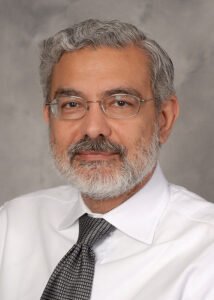
 President, The Alan and Marlene Norton Presidential Chair, SUNY Distinguished Service Professor
With the organization since: 1979
In current position since: 2020, named interim president in December 2018
Education: Holds a Doctor of Medicine degree from University of Bombay (currently Mumbai University). Conducted his residency at Upstate University Hospital in Syracuse.
Career Highlights: Served in numerous leadership roles at Upstate, including as chair of psychiatry, and interim dean of the Norton College of Medicine. As president expanded and enhanced local mental health services for adults and children, including the opening of the state’s only biobehavioral health unit for children with mental health needs and developmental disabilities. Also, led effort to provide enhanced mental health support for students in the Syracuse City School District. Has presided over record growth in research with a more than 30% increase in expenditures. The university’s economic impact now stands at $3.2 billion, nearly doubled the impact measured in 2008. In 2025, Upstate was named Business of the Year for Community Involvement by CenterState CEO. Dewan championed the creation of Upstate Biotech Venture to fund start-ups and small businesses. Led the university’s and SUNY’s response to COVID-19 pandemic, including the development of the world’s best saliva COVID diagnostic test. Worked with area legislators, governor to secure a historic $450 million in funding to support the building of a new hospital emergency department and burn unit, and has worked to expand Upstate’s health care services to the northern suburbs in anticipation of significant job creation in the area with upcoming economic development initiatives.
How do you describe your managerial philosophy or approach? “I focus on hiring the very best people who bring the best to classroom, laboratory and clinical site. We have an amazing level of talent here. As president, my job is not to tell them what to do. I lead by supporting them so they can be exactly who they are — the very best. What tools do they need? What colleagues do they need by their side? I give them the capacity and the wherewithal to excel.”
How do you see the healthcare industry changing in the next few years, and how will you prepare the organization for those changes? “The population growth we expect as CNY welcomes Micron will be a surge in demand for services, especially at Upstate, where we offer many one-of-a-kind services not offered elsewhere in the area. I remind folks that we need to expand access with excellence. We are already making strides in the area with more clinic capacity, especially in the northern suburbs where we’ve opened a pediatric and physical medicine and rehab offices. We are making changes in services to be able to add new beds, so we’re not turning people away who want to get their care here. Workforce pressures will still be significant if not worsen. We’re doing more with technology, such as our virtual admission and discharge, hospital at home program, use of robots in the hospital to do rudimentary task like delivering meals, supplies to patient care units, also looking at how the use of drones in drug and specimen delivery.”
How do you describe your managerial philosophy or approach? “I focus on hiring the very best people who bring the best to classroom, laboratory and clinical site. We have an amazing level of talent here. As president, my job is not to tell them what to do. I lead by supporting them so they can be exactly who they are — the very best. What tools do they need? What colleagues do they need by their side? I give them the capacity and the wherewithal to excel.”
How do you see the healthcare industry changing in the next few years, and how will you prepare the organization for those changes? “The population growth we expect as CNY welcomes Micron will be a surge in demand for services, especially at Upstate, where we offer many one-of-a-kind services not offered elsewhere in the area. I remind folks that we need to expand access with excellence. We are already making strides in the area with more clinic capacity, especially in the northern suburbs where we’ve opened a pediatric and physical medicine and rehab offices. We are making changes in services to be able to add new beds, so we’re not turning people away who want to get their care here. Workforce pressures will still be significant if not worsen. We’re doing more with technology, such as our virtual admission and discharge, hospital at home program, use of robots in the hospital to do rudimentary task like delivering meals, supplies to patient care units, also looking at how the use of drones in drug and specimen delivery.”
What are your top three priorities for your organization within the next year? “Our strategic plan has been streamlined to focus on two priorities: becoming better and becoming bigger—with ‘better’ always leading the way. Growth isn’t our goal for its own sake; it’s what enables true excellence. A small hospital can deliver outstanding care, but an academic medical center must excel across the spectrum. That’s the standard we’re driving toward, and I’ve asked our leadership team, including the four deans, to align around that vision.”