
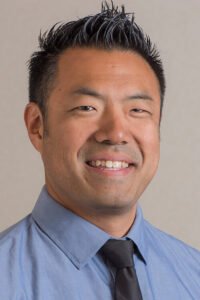
 Founder and principal at Richard Kim Medicine
With the organization since: 2014.
in the current position since 2014.
Education: Bachelor of Science degree from the University of Washington; Doctor of Medicine degree from Albany Medical College, where he completed a combined residency in internal medicine and pediatrics, followed by a fellowship in sports medicine. Holds board certifications in internal medicine and pediatrics, with a certificate of added qualification in sports medicine.
Skills that make you an effective leader? “As a physician we are used to being in education and academics. However, when we exit into the real world we are often faced with multiple forces pulling into as many directions. My best skill as a leader is identifying the student in each of my employees and enabling them with education, resources, direction and encouragement. This ultimately benefits everyone 360 degrees.”
How do you describe your managerial philosophy or approach? “In medicine the business of medicine is different than business built around a physical product and different still compared to other service industries. What we have found as a successful formula for both management and approach is being a good example. Rooting patient care in fundamentals of how we as patients or how we want our family to be treated in similar scenarios and situations I find to be the best managerial tone. It sets expectation and standard for every activity, every interaction and everything we as a group touch.”
How do you personally demonstrate leadership and inspire your staff? “So much of what we do on a daily basis is novel and unique. No two patients are alike and the challenges each patient presents is both what we look forward to and sometimes are frustrated by. As each new patient and each new challenge arises a consistent approach has been the clearest demonstration of leadership. This non verbal example illustrates what is expected and in times of challenge what is possible.”
How do you see the healthcare industry changing in the next few years, and how will you prepare the organization for those changes? “We have been and are incredibly fortunate. Early opportunity and early action led us down a path where we were able to explore a practice model that allowed complete and dedicated focus on one patient at a time, an almost unheard-of experience for patients now. Many physicians are strangled between production and revenue, with no room for emphasis on doctor-patient relationship, empathy or the art of medicine. For us, we will change nothing. This is exactly the way I wanted to practice medicine and it works for not only our patients but for us as a team as well.”
What are the top three priorities for your organization within the next year? “We have maintained the same priorities since inception and that is unlikely to change. These tenements have brought us this far and therefore proven. Our priorities include producing the highest quality experience, whether that be an in-office consultation down to a webpage interaction. Furthermore, we continue to hold highest regard to the importance of the doctor-patient relationship, everything we do in the office is to ensure this is preserved. Lastly building and maintaining the team dynamics we are so very proud of. I am particularly grateful for an amazing team that works fluidly and moves en masse to the ever-changing dynamics of taking care of another person.”
How can the healthcare industry in the region be improved? “Regional healthcare biosphere is a reflection of the exact challenges faced nationally. Subtleties exist, but by and large redundant everywhere and although volumes can be written and argued the one worthy of mentioning is physician autonomy. Restoration of physician autonomy has downstream effects that begin with trust in the medical system and end with lifting the quality of health care in America. However, restoration is more than simply pen to paper and reversal of decades of healthcare dollar mismanagement. Restoration entails overhaul of physician training and skill sets.”
Tell us one thing about you that people generally don’t know? “In 1999, on the Fourth of July I left for Kolkata (Calcutta), India. I left in search of a deeper anchor in caring for people. So, with one giant travel backpack I showed up on the doors of the Mother House – Mother Teresa’s Missionaries of Charity — with the intent that caring for people was going to achieve conviction or an amazing journey but a different path. Obviously, we know how that turned out. Please ask me about it, as it is one of my most cherished memories!”