
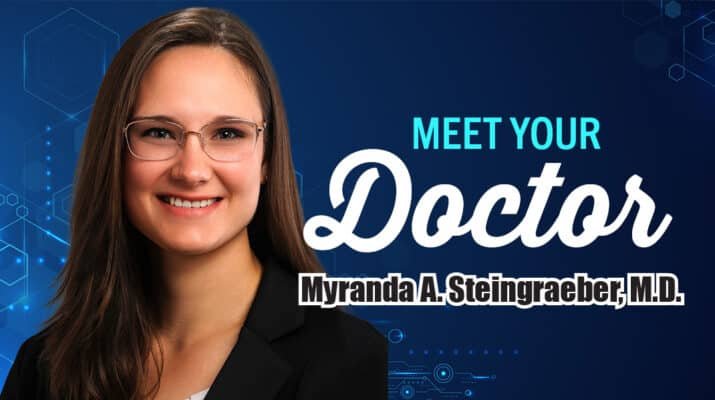
For a new physician, who started at Crouse in December, family medicine provides a unique window into long term patient care and treatment outcomes
By Chris Motola
Q: How recently did you join Crouse Medical Practice?
A: I started on Dec. 1, 2025.
Q: And what put Crouse on your radar?
A: I had a good experience with them when I was rotating through in medical school. I like the way that things are structured and I like that I get enough time with my patients, the way that they have my schedule set up.
Q: How recently did you finish your residency at Albany Medical Center?
A: My residency was completed at the end of June 2025. So, I am a little bit fresh out of residency. But I did my medical school before that here at Upstate in Syracuse.
Q: And you are in primary care? What’s your patient base look like so far?
A: Yes, I do family medicine. I get joy out of seeing people in every stage of life. So, I’ll I see anybody at this point and thankfully I have a staff that can do vitals on infants and babies and toddlers, so age 1 all the way up to 99.
Q: With the growing emphasis on specialties, what role do you feel primary care plays in the modern medical landscape?
A: I like that I get to see the person holistically. I think that it’s necessary to take a look at all aspects. And I think it’s important to sort of have somebody that you see consistently over time. You know, you might see an orthopedist for a year or two after an injury. You might see a cardiologist until things get stabilized and maybe a little bit after that. But I have the fortune of kind of being there throughout somebody’s life to really get to know them and their family. A symptom might be thought to be one thing in one specialist’s office and something else in another. And I kind of get to help coordinate all of that.
Q: Do you think that coordinating role put you in the position to get better outcomes for the patient long term?
A: Oh, absolutely. I don’t think I could quote the studies off the top of my head, but I know there are studies that have shown that. I think it’s a little different for everyone where their primary adds the most value. But certainly, I do spend a fair amount of time for my preventive visits talking about lifestyle modifications. And even for some of the acute visits, if you are having something like reflux, we can address underlying issues, make modifications to your lifestyle that might help address the root cause.
Q: What are traits you would recommend patients look for in a primary care physician?
A: I think they have to be comfortable with the primary care physician who says, “I don’t know. Let me look that up.” Or “let me phone a friend.” I think it’s important to find someone that you trust and feel like you can be honest with because we can’t help with something we don’t know about, and where we thrive is when we know the whole picture. So, you have to find somebody that you can feel comfortable talking about all kinds of symptoms with and that you don’t mind having a long-term relationship with.
Q: What’s the most challenging situation you’ve encountered in primary care?
A: I think it can be frustrating for doctors and patients when we get to a point where we’re kind of out of options. Whether that means available studies to try to work out what’s going on or medications to try to address somebody’s chronic pain or anything like that. But I also think that the flip side of that coin is that as a primary care doctor, we’re in the best position to stick with you through that time and try to keep collecting data, keep trying to investigate and treat. Ultimately, we’re in the best position to figure out what happens in the long-run and what the best treatment might be. Having symptoms but not finding answers can be tough on the patients and it’s hard to see someone struggle. But I also feel lucky to be in the place where I can see the long-term outcomes and because of that, when we do finally figure out it, it’s very rewarding.
Q: As a younger physician, what perspectives can you bring in contrast to those who have been practicing for decades?
A: Being fresh out of residency, being so close to med school, I am lucky to have been trained with the most up-to-date information. I think as you settle into practice, especially in primary care, you really have to prioritize and work hard to stay on top of all of these areas of learning and being aware of the latest research in all of the areas that we cover. Of course, I hope to learn from some of my peers here because they are excellent and very much on top of their knowledge.
Q: You speak German as well. Did you grow up speaking it or pick it up along the way?
A: A little bit of both. My mom is from Berlin, but she came over young enough to not have an accent. I spoke it a little bit at home growing up, just like nursery rhymes and little things, not fully fluent. And then I took it on in middle school through high school and then in college I minored in German, just to sort of keep up those skills and be able to communicate with my family.
Lifelines
Name: Myranda A. Steingraeber, M.D.
Position: Family medicine physician at Crouse Medical Practice
Hometown: Cobleskill
Education: Bachelor’s degree in biology and neuroscience, University of Rochester; medical degree, SUNY Upstate Medical University; residency, Albany Medical Center
Organizations: American Academy of Family Physicians, American Medical Association, American Board of Family Medicine
Family: Fiancé
Hobbies: Running, quilting, reading