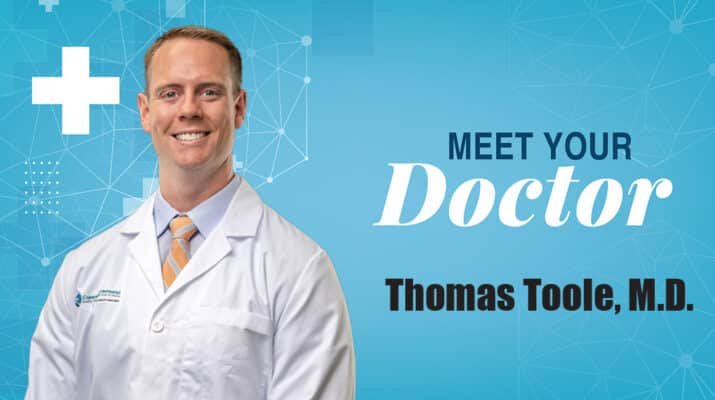
Orthopedic surgeon joins Community Memorial Hospital in Hamilton, the same hospital where he was treated for a broken arm when he was a kid. He discusses his professional path, his expertise and the hospital’s growing orthopedic program
By Chris Motola
 Q: What’s your role in the orthopedic program at Community Memorial Hospital?
A: I’m one of their newer additions. My specialty is in orthopedic sports medicine over at Community.
Q: Is this a surgical practice or more diagnostic?
A: It’s definitely surgical. I got my training in orthopedic surgery and then I did a specialty fellowship in sports medicine at University at Buffalo. And it includes both surgical and non-surgical care. It’s a bit of a general practice too because not only do I see sports medicine patients, but I see any kind of injury or any kind of orthopedic issue.
Q: So, when you are talking about orthopedic sports medicine, what kinds of injuries are you generally dealing with?
A: Yeah, so sports medicine is a little bit of a misnomer because yes, we do take care of sports injuries and issues related to athletes. But we also take care of things outside of that realm too. So really sports medicine is an extra specialization in procedures that are more minimally invasive. It mostly uses arthroscopy, like in the knees and shoulders and joints. So, what that really entails is things like rotator cuff tears on the shoulder, shoulder instability and then ligamentous injuries of the knee, meniscus, ACL and things of that nature. And then really any other kind of injury, whether it be in sports or just a farmer that hurts his knee while working. So it covers a wide range of injuries and issues.
Q: The idea being to get people kind of back on their feet as quickly as possible?
A: Exactly, exactly. That’s our main goal and I think that’s kind of the unique thing of orthopedics in general. But also sports medicine means we’re taking care of people with a goal to get back to their previous level of activity, whether it be a sport or a job. And our goal is to get them back to it as soon as possible — whether it be with surgery or without surgery.
Q: The orthopedic program at Community Memorial Hospital is fairly new, correct?
A: Yeah, it’s relatively new [it was launched in 2023], but it’s been impressive to see how fast it’s been growing.
Q: How recently did you join the team?
A: I joined in September 2025.
Q: So, coming in at this stage, what are you seeing? Does it feel like you are still early enough to make an impact on the direction of the program? What’s the vibe?
A: Yeah, I would say so, definitely. It’s exciting to see our growth into different communities, but also the sports world in this community as well. We’re trying to get more involved with local schools, with sports medicine practices and different gyms and things like that.
Q: What kinds of injuries do you see the most?
A: So we see a lot of knee and shoulder injuries in my field, probably some of the most common being rotator cuff injuries. For knee injuries would be meniscus-related, which is the cushion of our knee joints. Then you see different ligamentous injuries like ACL injuries in the knee as well. And then in my field, also, I do hip arthroscopy. So I see a lot of hip impingement and labral tears of the hip as well. I see quite a few of those. So, yeah, I’d say that those are the most common that I see.
Q: What are common causes of these shoulder and knee injuries?
A: Yeah, it can really be a huge range. Probably the typical story if you are in an athletic population, it’s a fall. Something where the shoulder or knee went into an awkward position and they either felt a pop or just acute onset of pain. The weekend warrior that’s out for a mountain bike ride and they have an injury or they’re even just doing some yard work and it’s an overuse thing. Or acute strain from lifting something too heavy. So it’s a really wide range of what brings people in to see us.
Q: Is it typically the result of overuse or is it like unbalanced muscles?
A: Yeah, kind of combination of everything. We definitely see overuse injuries, but sometimes that can be exacerbated by muscle imbalance or maybe poor coordination. And that’s we always try non surgical approaches first. That’s where physical therapy comes in to restore those muscle balances and compensate for whatever that issue is that’s leading to overuse symptoms.
Q: And how effective is surgery usually at returning like full function?
A: I would say very effective. We’re surgeons, but surgery is always the last resort. We always try physical therapy. We can try injections and things of that nature. But when everything fails, that’s when we start talking about surgery. Orthopedic surgery does a good job of getting people back to what they want to be doing in most cases.
Q: What kind of follow up is there usually after getting orthopedic surgery?
A: We definitely follow up closely. If a patient comes to see us, we’ll follow you along as you are recovering from whatever ailment you might have, whether it be surgical or non- surgical. We tailor follow-ups exactly to what the issue is, but we definitely try to walk you through the whole recovery process.
Q: What got you interested in this subspecialty?
A: My whole orthopedic journey actually started at Community Memorial Hospital when I was young. I broke my humerus bone, my arm bone. I was taken care of by Dr. Gallow at Community Memorial and that started my interest in orthopedics even at a young age. And then growing up, my dad was a large animal vet, which further piqued my interest in medicine in general. And then in my high school and college years, I had a couple sports injuries that needed surgery, so I was even further exposed to orthopedic surgery, especially sports medicine.
Lifelines
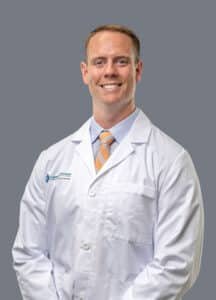
Name: Thomas Toole, M.D.
Position: Orthopedic surgeon at Community Memorial Hospital
Home: Cazenovia
Education: SUNY Upstate Medical University; sports medicine fellowship at the University at Buffalo, where he worked with team members of the Buffalo Bills and Buffalo Sabres
Of note: Served as program chair of the SUNY Upstate Orthopedic Surgery Interest Group and was honored with the prestigious David G. Murray, MD, Award for Excellence in Orthopedic Surgery
Affiliations: Community Memorial Hospital
Organizations: American Academy of Orthopedic Surgeons, American Orthopaedic Society for Sports Medicine, American Association Nurse Anesthesiology
Family: Wife
Hobbies: Hunting, hiking, fishing, mountain biking