
By Anne Palumbo
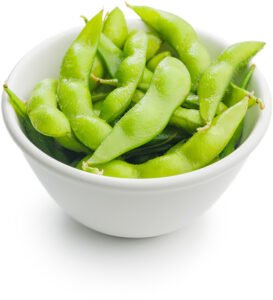 Tucked in the freezer aisle next to other vegetables lies a sneaky nutrient-dense legume: edamame.
While most Americans consume edamame as a starter or snack — it’s so fun to squeeze beans from the pod! — more and more are adding shelled edamame to all kinds of savory dishes.
Personally, I’ve been having a love affair with shelled edamame for years.
Besides its nutty flavor and buttery texture, I’m head over heels for this young soybean’s treasure trove of life-promoting nutrients.
Similar to other beans, edamame boasts impressive amounts of plant-based protein and fiber.
Consume just one cup and your body will thank you for those 18 grams of complete protein and 8 grams of fiber. Your waistline may thank you too since both protein and fiber take a while to digest and keep you full longer.
Could such a tiny bean help lower bad cholesterol and reduce the risk of heart disease?
The research on edamame says yes. Quite remarkably, edamame lowers this artery-clogging compound in a number of ways. Its soluble fiber grabs bad cholesterol and sweeps it out of the body. Its soy protein has been shown to reduce bad cholesterol levels by potentially helping the liver give it the boot. And its healthier unsaturated fats reduce plaque buildup in arteries and decrease inflammation.
Hmm…edamame or red meat loaded with saturated fat? Let’s ask our hearts!
Also, the moment I discovered edamame might reduce bone loss, my creaky bones and I did the happy dance.
What’s so amazing is edamame’s impressive number of nutrients that contribute to bone health—from its calcium to vitamin K, magnesium to phosphorous, protein to iron, and more. This lean, green bean is also rich in isoflavones, which are plant compounds that can mimic the bone-protective effects of estrogen in the body.
On that topic: Some people avoid eating soybeans regularly because they’re worried isoflavones will exert estrogen-like effects or increase risk of breast cancer.
Scientific evidence shows no association between soy consumption and breast cancer. Studies also show that soy consumption does not cause breast enlargement in men or a drop in testosterone levels.
Helpful tips
In many supermarkets, you can find two types of edamame in the frozen vegetable section: shelled or with the pods. Both are already cooked and ready to be thawed and eaten. Edamame is generally safe for most people, but those with soy allergies should avoid them.
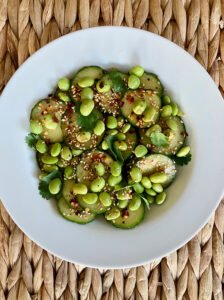 Cucumber Edamame Salad
Serves 4
Ingredients
▪ 1 cup shelled edamame, frozen
▪ 1 large English cucumber, thinly sliced
▪ 1/2 cup fresh cilantro, rough chop or diced
▪ 1 ½ tablespoons rice wine vinegar
▪ 1 ½ tablespoons lite soy sauce
▪ 1½ to 1 tablespoon sesame oil
▪ 1-2 cloves garlic, minced
▪ 1 teaspoon grated ginger
▪ ¼ teaspoon coarse black pepper
▪ ½ teaspoon crushed red pepper flakes, optional
▪ 1 tablespoon sesame seeds
Instructions
1. Cook edamame according to package directions. Set aside 1 cup (or more).
2. Cut the ends off the cucumber; leave the skin on. Then, use a knife or mandolin to thinly slice. Thickness is up to you.
3. Add the slices to a strainer and lightly coat with salt. Mix well and let sit for 10 minutes to draw out the water.
4. After 10 minutes, lightly rinse the cucumbers, pat dry, and add to a medium mixing bowl, along with the edamame.
5. In a small mixing bowl, whisk together the vinegar, soy sauce, sesame oil, garlic, ginger, black pepper, and red pepper flakes (if using).
6. Pour the dressing over the salad and mix well. Serve as is or garnished with sesame seeds.
Anne Palumbo is a lifestyle columnist, food guru, and seasoned cook, who has perfected the art of preparing nutritious, calorie-conscious dishes. She is hungry for your questions and comments about SmartBites, so be in touch with Anne at avpalumbo@aol.com.