
By Deborah Jeanne Sergeant
Generally, food allergies tend to cause immediate systemic responses such as hives, anaphylaxis and GI upset. Food sensitivities tend to cause more delayed GI responses including diarrhea, vomiting and stomach upset.
Diagnosis of a food allergy or sensitivity can feel overwhelming at first, especially when navigating prepackaged foods.
“Reading food labels carefully is one of the most effective ways to avoid accidental exposure to allergens,” said physician Haidy Marzouk, at St. Joseph’s Health. “However, food labels can often be confusing, with ingredients that may be related to allergens but so long that they are hard to pronounce.”
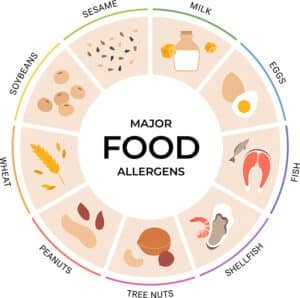
She noted that 2004’s Food Allergen Labeling and Consumer Protection Act required packaged foods to clearly identify the presence of the eight major allergens — milk, eggs, fish, crustacean shellfish, tree nuts, peanuts, wheat and soybeans — and in 2023, sesame was added. Paying attention to this list and asking about unpackaged foods “can significantly reduce the risk of unexpected allergen exposure,” Marzouk said. “When looking for information online about food allergies, information on the internet can be hit or miss. Assessing accuracy of information and what’s research based can be challenging. Health websites such as those run by federal agencies, medical schools or major nonprofit organizations are typically a good starting point because they clearly identify who runs the site, provide balanced, research-based content and offer transparent contact information for questions or feedback. Taking these steps helps ensure that the food allergy information you rely on is accurate, current and based on sound medical knowledge.”

Some people are sensitive enough to allergens that cross-contamination such as equipment processing allergens and non-allergens would trigger a response. Look for “processed in a facility that also processes…” on the label.
Reading every label, every time is essential, even if it is a food you have purchased before. The volatility in the food system can mean the new owner of a food processor can change the ingredients.
Some ingredient names are not as easily understood.
“There are a few misnomers like whey or casein that are from milk,” said Jonathan Yuhas, registered dietitian and owner of Yuhas Nutrition in North Syracuse. “The protein of the food is what causes the allergic response.”
A term like “natural flavoring” can refer to any number of food ingredients. “Malt” or “modified food starch” could bother someone with celiac disease as these may derived from grains containing gluten.
Yuhas added that packaged products — if they’re not a single food item — can have additives or preservatives that can have risk of contamination.
Not all packaged foods bear the same types of labels. Food purchased from a stall at a farmers’ market or table at a bulk foods store may have minimal information. People with food allergies or sensitivities should ask careful questions to ensure that they know what they are eating.

A good strategy for eating out can be making a list of go-to items at chain restaurants and at independent restaurants asking a lot of questions.
“It’s not just the foods, but the condiments, sauces, dressings and oils used in preparation,” Yuhas said.
Greg Belzak, registered dietitian and owner of Step Nutrition in East Syracuse, warned that at restaurants, even use of the same implements for different foods can cause problems.
“It’s not necessarily in plain view, even if you think you’re ordering the right thing,” he said. “Chefs will accommodate things if you have things like celiac disease. When calling ahead of time, a lot of times, they will tell you. Some chain restaurants have it displayed somewhere. Check the websites of chains.”
The less package information, the more questions people should ask.
“Farmers’ markets or bulk foods aren’t required to use those terms,” Belzak said. “With bulk foods, people may use the same scoop which can be a problem for people who are very sensitive.”

Emily Gozy, registered dietitian nutritionist and owner of Nourished with Emily, LLC in Syracuse, tells patients with food allergies to “look for the simplest item on the menu.”
The least amount of preparation can reduce risk of contamination, as preparation “is where a lot of cross contamination happen as a lot of restaurant staff may not know if something has gluten in it. Rice and steamed vegetables is safer than something with sauce,” she added.
Some allergies can cause a response even if the offending food is not ingested, such as an extreme peanut allergy.
“Some people can’t go to Five Guys or Texas Roadhouse because the peanut dust is on the walls or railings,” Gozy said. “It can trigger anaphylactic reaction. When someone is newly diagnosed it can be overwhelming. It’s easy to go down the rabbit hole in groups on Facebook, but most often those people aren’t taking care of themselves. Put the selective reading glasses on and realize what you can try versus the loud commentary that can make it so much scarier than it has to be.”
Did you know?

Did you know that gluten sensing dogs are helping people with celiac disease detect gluten? Trained as assistance animals, these dogs can alert their owners by a signal such as pressing their nose to the owner’s leg to signal the presence of gluten so the owner can avoid it.
How does it work? According to www.celiacservicedogs.com:
• “Dogs have 300 million smell receptors compared to just six million in humans.
• They can smell things at concentrations 100 million times lower than humans. Even when we don’t notice a scent, they can.
• They use Jacobson’s organ (also called the vomeronasal organ), which helps them detect large proteins like gluten. Even though gluten doesn’t easily go airborne, dogs can still pick up on it.
• You can see their body language change when they catch a scent. Whether they’re searching a room or sniffing a package, their behavior shifts noticeably when they find gluten.”