

By Anne Palumbo
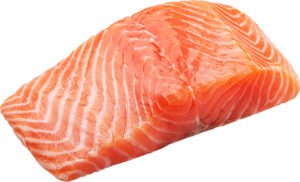 For over 20 years now, experts have been recommending that we eat salmon twice a week to maximize health benefits: not a huge amount, mind you, just portions roughly equivalent to a deck of cards.
I can do that, I thought, when I first heard the recommendation.
But I didn’t.
These days, however, I’m making a herculean effort.
Why the change?
Well, I’m older…and constantly forgetting things…and not as strong as I once was…and forever worried about inflammation. Did I mention my creaky bones? Yeah, those rickety things, too.
Salmon, deemed the “superfood of the sea,” provides a potent combination of essential nutrients that can help with all of the above (and more!).
Let’s start with the heart.
Grouped with “fatty fish” like herring and sardines, salmon is anything but fat. Its nod arrives from its ultra-rich concentration of omega-3 fatty acids—beneficial compounds that may help us live longer by reducing the risks of heart disease, heart attack and stroke.
Research suggests these fatty acids work their wonders by helping to decrease blood pressure, slow the buildup of arterial plaque and reduce “bad” cholesterol. What’s more, omega-3s can provide powerful protection from chronic inflammation, which experts believe is a key contributor to many diseases, including cancer, Type 2 diabetes and obesity.
Can’t find your glasses sitting on top of your head? Ditto, which is why salmon and I are meeting twice a week now. Studies show that regular salmon consumption may be linked to better memory, reduced brain shrinkage and a lowered risk of neurodegenerative diseases like Alzheimer’s. Once again, the brain-building omega 3s are the might behind all these benefits.
You know what else I can’t find these days? My arm muscles. Aware that protein is crucial for maintaining and improving muscle strength, especially in my seasoned age group, I look to salmon to boost my intake. An average serving (about 4 oz) delivers a whopping 25 grams for less than 300 calories.
Lastly, salmon is one of the rare foods that provides a good amount of vitamin D, a critical nutrient for calcium absorption, bone health, and preventing osteoporosis. Depending on whether your salmon is farmed or wild, you can get up to 100% of your daily needs in one serving. (Wild-caught generally offers more.)
Helpful Tips
Since the nutritional value of farmed versus wild-caught salmon is comparable, experts recommend we focus more on sourcing and labels. A high-quality, healthy, and sustainable salmon label should feature clear information regarding its origin, species and third-party certifications.
Also, since a good portion of raw salmon carries parasites, bacteria and viruses, the USDA recommends cooking salmon to an internal temperature of 145 F.
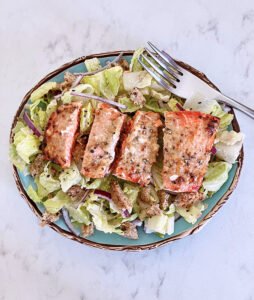
Parmesan-Crusted Salmon Caesar Salad
Serves 4
Adapted from cookbook author Jerrelle Guy
 Ingredients
¼ cup lite mayonnaise
¼ cup plain Greek yogurt
2 garlic cloves, minced
2 tablespoons lemon juice
2 teaspoons balsamic vinegar
2 teaspoons coarse-ground Dijon mustard
1 teaspoon Worcestershire sauce
½ teaspoon coarse black pepper (or less)
½ teaspoon kosher salt
½ cup finely grated Parmesan, plus more as needed
4 (3- to 4-ounce) skinless salmon fillets
2 heads romaine lettuce, chopped or torn into bite-size pieces
½ small red onion, halved and thinly sliced
Garnishes: more Parmesan and croutons
2 teaspoons fresh lemon juice
Instructions
1. Heat oven to 375˚F and place rack in center. Line baking sheet with aluminum foil or parchment paper.
2. Make the dressing: In a small bowl, whisk together the mayonnaise, yogurt, garlic, lemon juice, vinegar, Dijon mustard, Worcestershire, pepper, and salt. Adjust the seasoning if desired.
3. Remove ¼ cup dressing, and place in a small mixing bowl; add ¼ cup grated Parmesan. Mix to combine.
4. Pat salmon dry with a paper towel, and season lightly with salt and pepper. Using a pastry brush, liberally coat the fillets all over with the ¼ cup dressing-Parmesan mixture.
5. Place on the baking sheet, top fillets with the remaining ¼ cup grated Parmesan, and cook for 10-12 minutes. Remove from oven.
6. Place the rack 6 inches below broiler and turn on broiler. Return salmon to oven and broil for about 4 minutes more to crisp up top. Watch carefully to avoid burning.
Remove salmon from the oven, and allow a few minutes to cool slightly. Leave whole or slice each fillet into 4 pieces.
7. Add the lettuce and sliced onion to a large bowl. Drizzle in some of the dressing and, using tongs, toss to evenly coat the leaves. Divide across salad plates and sprinkle with more Parmesan and croutons, if desired. Top each salad with a fillet (whole or sliced) and serve.
 Anne Palumbo is a lifestyle columnist, food guru, and seasoned cook, who has perfected the art of preparing nutritious, calorie-conscious dishes. She is hungry for your questions and comments about SmartBites, so be in touch with Anne at avpalumbo@aol.com.