

Want to lose weight? A daily amble won’t do it
By Deborah Jeanne Sergeant
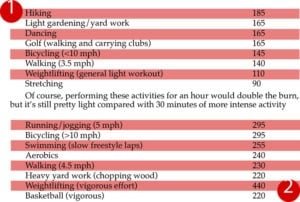
Of course, any movement is better than no movement. But to really torch calories you need to move more than gently stretching and walking to the end of the block and back.
A half hour of moderate exercise burns few calories such as (according to the Centers for Disease Control, based on a 154-pound person): Chart 1-2
Naturally, you may need to start out a rigorous activity at a more moderate pace until you reach a level of strength and fitness needed to fully engage, such as cycling slower or alternating running a quarter mile with walking a quarter mile.
More intensive workouts can help you burn more calories and drop weight by creating a calorie deficit in the same amount of time as exercising at a slower rate or with a lighter activity. Your body will burn more stored fat to keep up with your activity level. With your healthcare provider’s approval, consider engaging in a calorie-blasting activity.
High intensity interval training (HIIT) has become popular because of its ability to help people burn calories in a short period of time. Kimberly Whitcomb, certified personal trainer who provides one-on-one training in Wolcott, said that many bodies “respond better for weight loss with HIIT” than many other methods of exercise and that many people could benefit from strength training on alternating days with HIIT.
HIIT workouts involve working the body as hard as possible for a determined interval, slowing the rate for a short “rest” period and then repeating the cycle a few times. Alternating the HIIT activity can also prove beneficial.
“It causes the body to work a little harder,” Whitcomb said.
The difficulty of many types of activities could be increased through applying the principles of HIIT. Genevra Petito owner/operator of Supergirl Fitness in Rochester, likes using an elliptical machine for HIIT “for the comfort of my joints.”
She offered as an example starting with a five- to 10-minute warmup followed by a five-minute regimen of 15 seconds fast and 45 seconds slow.
“Do five total intervals and see how it goes,” Petito said. “Monitor your heart rate and comfort level and stay hydrated.”
Then cool down for five to 10 minutes.
Petito also wears a weighted vest while doing a HIIT workout.
“For people whose body can tolerate the impact, jumping movements are important and effective to maintain power, speed, agility, reactivity and also calorie-blasting,” Petito added. “However, they’re not always appropriate for people with osteoporosis, osteoarthritis, low-back dysfunction and foot neuropathy.”
Naturally, you can overcompensate for the fast calorie burn with more food, thus negating the calorie deficit.
“You need exercise and a reduced-calorie diet,” said Kenneth Cooper, doctor of osteopathic medicine at Center for Weight Loss & Surgery at Crouse. “That’s the best way to lose weight. There’s no question those activities that will make you short of breath make you work harder. If you’re not breaking a sweat, you’re not burning many calories.”
Nonetheless, for people seriously out of condition, any movement is good and gradually increasing activity level will eventually result in weight loss as long as they reduce calorie consumption.
“It’s sound advice to include that if someone has not been exercising regularly or wants to increase their activity level to check with their doctor to keep it safe,” Cooper said.