

By Anne Palumbo
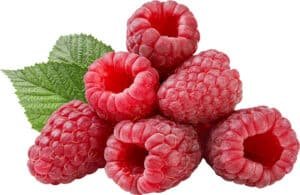 I’m always thrilled when foods as dainty and luscious as raspberries turn out to be nutrient-dense powerhouses.
I confess, their sumptuousness often distracts me from thinking about how good they are for hearts, brains and blood sugar control.
How do these heart-shaped jewels help hearts?
Much like other red berries, they’re loaded with antioxidants, which help protect your cells against oxidative stress—stress that results from too many bad molecules and not enough good molecules to neutralize them. This stress then damages cells and increases inflammation.
Chronic inflammation is not a good thing. Not only does it impair your heart by promoting plaque buildup in the arteries, but it also causes the heart muscle to become weak or stiff, which can lead to heart failure.
Unfortunately, inflammation’s unchecked silence can mislead us into believing all’s well when everything is not. Which is why it’s so critical to eat healthy, exercise and get regular checkups.
Lately, I’ve been misplacing things on a daily basis. And I can never remember “oh-what’s-his-name” who lives down the street. You, too? Welcome to the forgetful party, a party that seems to be growing by leaps and bounds. Since brain cells are especially vulnerable to inflammation and oxidative stress—two processes linked to Alzheimer’s and Parkinson’s—upping raspberry intake could be beneficial. Worth noting: In a decade’s long study of nurses, those who ate more berries had better brain function after age 70.
Here’s a moving surprise: Raspberries are one of the highest-fiber fruits, providing 8 grams per cup—a sizeable chunk of our daily needs. Along with keeping us regular, fiber helps regulate blood sugar by slowing down the digestion of food and the absorption of glucose, preventing rapid spikes after meals. Numerous studies show that persistent spikes can lead to insulin resistance, prediabetes, and eventually Type 2 diabetes.
Low-sugar, low-calorie, and fat-free, raspberries may also help with weight management.
Helpful Tips
Fresh raspberries are highly perishable; use as soon as possible after purchasing or picking to ensure the best flavor and appearance. Choose berries that are ripe, plump and firm. Frozen raspberries are just as nutritious as fresh—and in some cases, more. When raspberries are flash-frozen at peak ripeness, they often retain more vitamins, minerals and antioxidants than fresh berries, which can lose nutrients during transport and storage.
Raspberry Crumble Tart
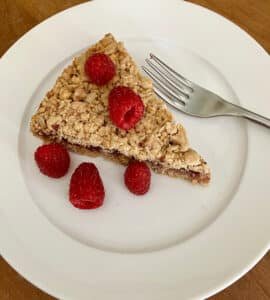 Serves 8-10
Ingredients
▪ 1 cup pecan or walnut halves, toasted and coarsely chopped
▪ 3 cups fresh or frozen raspberries
▪ 1 1/2 cup all-purpose flour
▪ 1¼ cups old-fashioned rolled oats
▪ 1/3 cup sugar
▪ 1/3 cup packed light brown sugar
▪ ½ teaspoon salt
▪ ½ teaspoon baking soda
▪ ¾ cups unsalted butter, melted
▪ ¼ cup sugar
▪ 3 tablespoons cornstarch
▪ 2 teaspoons fresh lemon juice
Instructions
1. Heat oven to 350 F with rack in center.
2. Lightly oil or butter a 9-inch springform pan; line the bottom with parchment paper.
3. Spread the nuts on a baking sheet and toast in the oven about 8 minutes. Let cool; coarsely chop and set aside.
4. Rinse and drain raspberries in a colander. Tap on counter to remove more water. Set aside. (Rinse frozen raspberries in colander until thawed and water runs mostly clear. Gently press with a spatula to get excess water out.)
5. In a large bowl, mix together the flour, oats, sugars, salt, baking soda, and chopped nuts. Add melted butter and, using fingertips, work butter into mixture until evenly moistened.
6. In a medium bowl, mix together the berries, sugar, cornstarch, and lemon juice.
7. Press half of the oat mixture into the prepared baking pan and press into an even layer. Evenly distribute the fruit mixture over oat layer, coming within1/4 inch of all edges. Sprinkle top with remaining oat mixture, then lightly press into fruit mixture.
8. Bake in preheated oven until golden brown, about 40-45 minutes.
9. Remove from oven and allow to cool completely before removing metal ring. For best results, chill 1-2 hours before cutting and serving. Keep leftovers covered and stored in the refrigerator.
Clarification: Edamame Smartbites
Edamame’s unsaturated fats do not reduce plaque (as a statin would). Rather, these healthier fats lower the potential for plaque buildup by helping the liver remove “bad” cholesterol from the blood—the primary driver for plaque formation.
 Anne Palumbo is a lifestyle columnist, food guru, and seasoned cook, who has perfected the art of preparing nutritious, calorie-conscious dishes. She is hungry for your questions and comments about SmartBites, so be in touch with Anne at avpalumbo@aol.com.